Electric cooking is becoming more popular in modern homes because it is cleaner, safer, and more energy-efficient than traditional gas cooking. Many households are also switching to electric stoves because of rising gas prices and the growing use of solar power systems.
In countries like Japan and many parts of Europe, electric cooking is already common in daily life. Modern kitchens now prefer electric stoves because they reduce smoke, improve kitchen safety, and offer better cooking efficiency.
However, choosing the right electric stove is important because every type works differently. Some consume more electricity, while others cook faster and waste less energy.
There are three main types of electric cooking stoves available today:
- Coil Heating Element Stoves
- Infrared Stoves
- Induction Stoves
Each stove has its own advantages, disadvantages, efficiency level, and electricity consumption.
Contents
Coil Heating Element Stove
The coil heating element stove is one of the oldest electric cooking technologies. It uses a metal heating coil that becomes red hot when electricity passes through it.
This same heating technology is also used in devices like electric irons, soldering irons, and heat guns. Heat is generated because the wire inside the element has high electrical resistance. When current flows through the wire, resistance produces heat.
How Coil Stoves Work
The heating element sits below the cookware. As the coil becomes hot, heat slowly transfers to the cooking pot placed above it.
Since air exists between the heating element and the cookware, a large amount of heat is lost before reaching the pot.
Because air is a poor conductor of heat, cooking becomes slower and less efficient.
Efficiency of Coil Heating Element Stoves
Coil stoves are considered highly inefficient for regular cooking.
Only around 20% of the energy is effectively used for cooking, while nearly 80% of the heat is wasted.
This leads to:
- Higher electricity bills
- Slower cooking
- More heat loss
Problems With Coil Heating Element Stoves
- Very low efficiency
- High electricity consumption
- Slow cooking speed
- Not ideal for solar-powered systems
- Excess heat spreads into the kitchen
Because of these disadvantages, coil stoves are no longer considered the best option for modern kitchens.
Infrared Stove
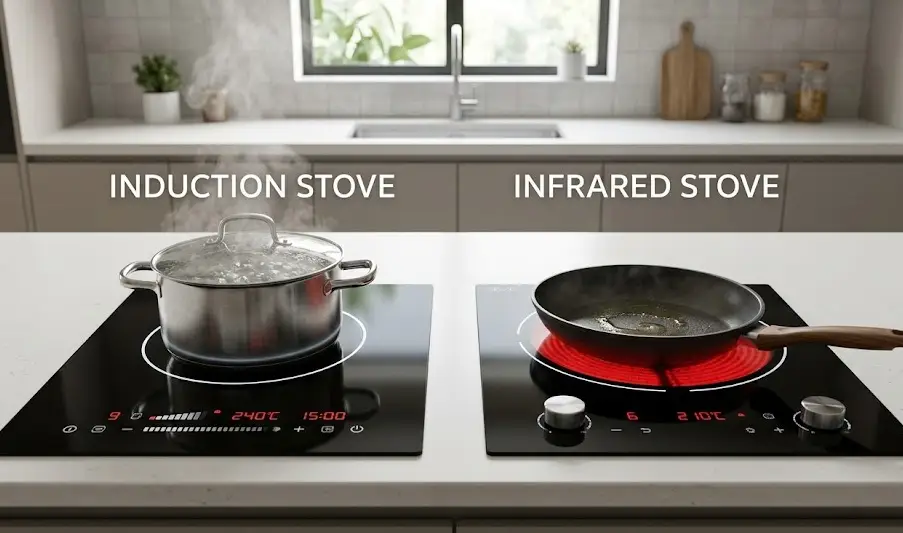
Infrared stoves are an improved version of traditional heating element stoves. Manufacturers added a ceramic surface above the heating element to improve heat transfer and cooking performance.
Although they are called infrared stoves, the internal technology still relies on a heating element.
How Infrared Stoves Work
The heating element heats the ceramic glass surface, and the cookware receives heat through direct contact with that surface.
Flat-bottom cookware performs best because it creates better contact with the ceramic top. Better surface contact improves heat transfer and cooking efficiency.
Cookware with curved or round bottoms does not work efficiently on infrared stoves.
Efficiency of Infrared Stoves
Infrared stoves are much more efficient than traditional coil stoves.
Their average efficiency is around 60%, making them a practical choice for many households.
Advantages of Infrared Stoves
- More affordable than induction stoves
- Better efficiency than coil stoves
- Supports most flat-bottom cookware
- Easily available in local markets
- Cleaner than gas cooking
Disadvantages of Infrared Stoves
- Uses more electricity than induction cooking
- Slower cooking speed compared to induction
- Round-bottom cookware performs poorly
- Ceramic surfaces can become very hot
Infrared stoves are still a good option for homes looking for affordable electric cooking solutions.
Induction Stove
Induction stoves are considered the most advanced and efficient electric cooking technology available today.
Instead of using direct heating elements, induction stoves use electromagnetic induction to generate heat directly inside the cookware.
How Induction Cooking Works
Inside the induction stove, a copper coil carries high-frequency electric current. This creates a changing magnetic field.
When compatible cookware is placed on the stove, eddy currents are generated inside the cookware itself. Due to the resistance inside the metal, heat is produced directly within the pot or pan.
Unlike traditional stoves, the cooking surface itself stays relatively cool while the cookware heats rapidly.
Compatible Cookware for Induction Stoves
Induction stoves only work with cookware made from ferromagnetic materials.
A simple magnet test can check compatibility:
- If a magnet sticks to the cookware, it will work on induction
- If the magnet does not stick, it will not work
Flat-bottom cookware is also necessary for proper energy transfer.
Efficiency of Induction Stoves
Induction stoves are extremely efficient.
Their efficiency is around 85% to 90%, which is far better than gas stoves and other electric stoves.
For comparison:
- Gas stoves usually operate at only 30% to 35% efficiency
- Coil stoves operate around 20% efficiency
This means induction cooking wastes far less energy.
Advantages of Induction Stoves
- Very high energy efficiency
- Faster cooking performance
- Lower electricity waste
- Safer than gas cooking
- No gas leakage risk
- Less heat spread inside the kitchen
- Cleaner cooking environment
- No smoke or soot buildup
- Better for homes using solar systems
Cooking speed is noticeably faster. For example, a task that takes 10 minutes on gas may take around 7 minutes on an induction stove.
Induction cooking is now widely used in countries like Japan, South Korea, the United States, and many European nations.
Disadvantages of Induction Stoves
- Requires special cookware
- Existing cookware may not work
- More expensive than infrared stoves
- Flat-bottom cookware is necessary
Some households use both induction and gas stoves together. This provides flexibility during electricity outages while still benefiting from induction cooking during normal use.
Which Electric Stove Is Best for Cooking?
Among all three options:
- Coil heating element stoves are outdated and inefficient
- Infrared stoves are affordable and suitable for basic cooking
- Induction stoves offer the best performance and efficiency
For households planning long-term electric cooking or solar-powered cooking, induction stoves are the best choice.
However, if the budget is limited, infrared stoves can still provide a practical and reliable solution.
Conclusion
Electric cooking is now a practical solution for daily household use. Modern electric stoves offer cleaner kitchens, safer cooking environments, and better energy efficiency compared to traditional gas systems.
Coil heating element stoves consume large amounts of electricity and provide poor efficiency. Infrared stoves improve cooking performance and support most flat cookware. Induction stoves deliver the highest efficiency, faster cooking speed, lower energy waste, and a more comfortable cooking experience.
For homes using solar energy or planning a long-term shift toward electric cooking, induction stoves are considered the strongest and most future-ready option.
FAQs
Which electric stove is most efficient for cooking?
Induction stoves are the most efficient, offering around 85% to 90% efficiency.
Can normal cookware be used on an induction stove?
No. Only cookware made from magnetic materials can work on induction stoves.
Why are infrared stoves called infrared stoves?
They still use heating elements, but the heating process produces infrared radiation before the element becomes visibly red.
Are coil heating element stoves suitable for solar systems?
No. Their low efficiency causes high electricity consumption, making them unsuitable for solar-powered cooking.
Which electric stove cooks food faster?
Induction stoves cook faster because heat is generated directly inside the cookware instead of heating the stove surface first.