
The biggest challenge for every new freelancer is finding clients. And the reason it feels so hard is one classic problem: to convert a client, you need a portfolio, and to build a portfolio, you need clients. So, where exactly do you start and how?
The good news is that you do not need any paid clients to build a strong freelance portfolio. In this article, you will learn exactly how to build a solid portfolio without any prior experience.
Here are four methods that actually work.
Contents
Method 1: Do the Work for Yourself and Treat Yourself as a Client

This is the easiest and most effective method of all.
If you are applying for a social media manager role, start by working on your own social media profile. Put in real effort. Grow your Instagram. Work on engagement, followers, and lead generation, just like you would do for a paying client.
If you are a graphic designer, create your own logo, make your own posts, and design your own thumbnails. If you are a video editor, edit your own videos and add them to your portfolio.
When you do this, you build the most authentic portfolio possible. Think about it this way: if you personally have zero followers, or 50 to 100 followers, and you are telling a client that you will get them 10,000 followers, why would they believe you? But if you have done it for yourself first, that proof is right there.
This is the best thing you can do to start converting clients, and it is also the simplest thing to begin with right now.
Method 2: Do an Internship with an NGO or a Startup
The second method is doing an internship, and ideally with an NGO or a startup.
Why an NGO?
When you work with an NGO, you are contributing to something good for society. In return, they allow you to use their name as a work reference or portfolio piece.
NGOs are also very easy to get internships with because they almost always need help and have very limited budgets. That means they are very open to unpaid interns.
Why a Startup?
Working with a startup teaches you a lot. Getting an internship at a startup is actually easier than most people think, especially when applying for unpaid positions. Startups move fast and give you real, hands-on experience.
How to Find These Internships
Direct Outreach: Find NGOs or startups on social media and reach out to them directly on their pages or profiles wherever you spot them.
LinkedIn: Search for NGOs and startups on LinkedIn and apply directly there.
Also: Your College Placement Cell
If you are a full-time college student, this is something you should not skip at all. The college placement cell can be very helpful for finding internships and freelance projects.
There are opportunities available there that you might not find anywhere else. This is a must-do if you are an absolute beginner.
Method 3: Do Free Work for Exposure
This method is often debated in the freelancing community, but doing unpaid work for the right people can be genuinely valuable when approached correctly.
When you work for free for someone experienced, you often get access to real-world knowledge that no paid course typically offers.
Things like how to write a strong introduction, how to structure your work, and how to handle different types of projects are skills that come from actual working experience.
When someone with years of expertise is guiding you, that learning has real market value, even if the work itself is unpaid.
The key is to work for someone you genuinely want to learn from. You can do this either in the form of an internship or as a freelance project.
Important: Make Sure You Are Not Being Exploited
If someone is getting your work for free, they should actually be teaching you something valuable in return. Especially in the freelance case, they should not be expecting too much from you.
If someone is asking you to work six, seven, or eight hours a day for free, that is too much. Two to three hours a day is reasonable.
You can do a little more if you have nothing else going on, but always know your limits. And do not continue it for a very long period of time.
How to Find People to Work For
Reach out personally to whoever you want to work with, whether that is a big company, a content creator, a freelancer, or an agency owner.
Tell them clearly why you want to work for free. If your message feels genuine to them and they have a real need, they will most likely end up considering you.
Method 4: Recreate Existing Work
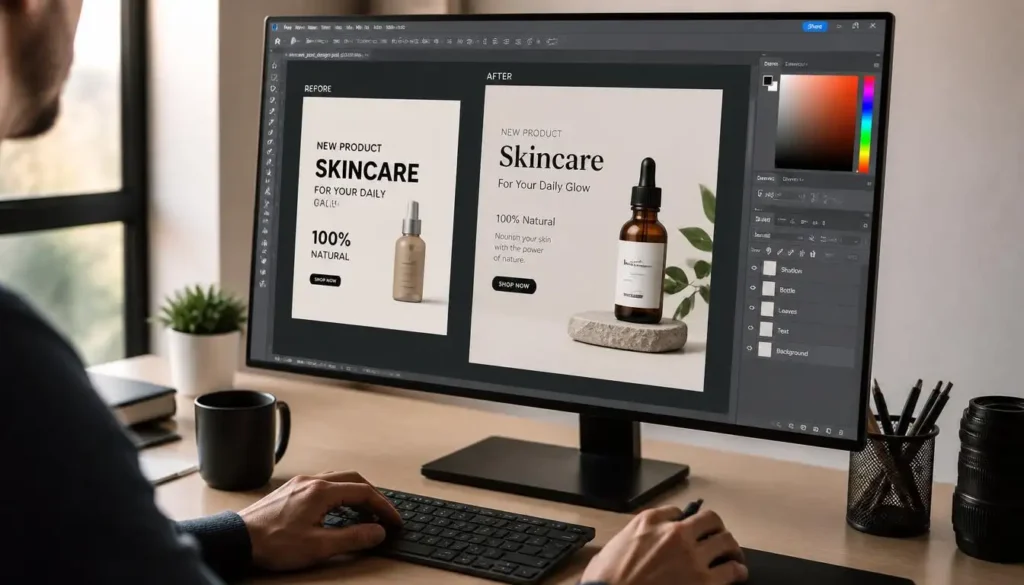
This is one of the smartest methods available and it serves more than one purpose at the same time.
Here is how it works. Look at existing content around you. Watch something and feel like the editing could have been done better? Go and redo that edit and add it to your portfolio.
See a social media post that you think was not done well? Make a better version of it. Come across a thumbnail? Recreate it your own way. See a landing page copy or an ad copy that has room for improvement? Rewrite it in a better version.
The key idea is to look at the type of clients you want to work with, whether that is businesses, individual creators, small companies, or large brands, and recreate their existing work in a better version wherever you see scope for improvement.
The Two Big Benefits of This Method
The first benefit is that you build your portfolio with conceptual or mock work, which is a perfectly valid way to show your skills to potential clients.
The second benefit is that you can reach out directly to the person whose work you recreated. Tell them something like: “I felt this could have been done better, so I went ahead and did it.
Make sure to check it out.” If they like your work, they might offer you paid work right away.
And even if they do not reply, you can post your recreated work on social media and tag that person. Either that person sees it, or their followers do, or your own audience does. Either way, people get to see your expertise and may end up reaching out to you directly.
With this one method, you can hit two targets at the same time.